Tuesday, January 2, 2024

Sandwich with mortadella


What could be better than a sandwich with mortadella? The answer is a mortadella sandwich enriched with a delicious pumpkin cream, a fresh peach jam flavored with ginger and chilli, sautéed spinach and scrambled eggs. If you think this is not possible, then get ready to discover one of the richest versions of the classic sandwich. A real meal in its own right that contains the strength of proteins and vitamins from vegetables in a small chest of bread. A foolproof, nutritious and appetizing sandwich. As is often the case in nutrition, it is not only the individual elements that are essential for our livelihood, but also their combination. 

The combination of cured meats and fruit, for example, turns out to be one of the most important because the iron contained in the former is enhanced, or rather activated, by the vitamin C of the fruit. In this case, iron-rich spinach is combined with peach jam and pumpkin, sources of vitamin C, and therefore the metal becomes immediately available and useful for the body. So play with combinations and don't be afraid to be daring from the point of view of flavors. 

INGREDIENTS

4 sandwiches
4 scrambled eggs
160 g mortadella
200 g spinach
1 tbsp pine nuts
1 tbsp raisins
salt to taste
1 tablespoon extra virgin olive oil
320 g pumpkin
2 tbsp peach jam
fresh ginger to taste
fresh chili pepper to taste

GUIDELINES

Prepare the pumpkin. Peel and cut the pumpkin into chunks. Sauté it for 15 minutes in a pan with very little oil. When cooked, season with salt and mash it lightly with a fork to make it creamy. Set aside. Make the spinach. Now sauté the spinach well cleaned, raw, in a pan with a little oil, pine nuts and raisins. Let them soften by reducing in volume and season with salt. Turn off the heat and let it cool, removing excess water. Flavor the jam. Grate the ginger, trying to collect its juice as well, and pour everything into a bowl with the peach jam. Also add the thinly sliced chilli, with all the seeds. Stir thoroughly and let it rest. Assemble the sandwich. Cut the bread in half, remove some of the crumbs and heat it on a hot griddle. Spread the jam first, then add the pumpkin, spinach, mortadella slices and finally the scrambled egg. Close the sandwich and serve!


Smoked salmon sandwich


Smoked Salmon Sandwich is a typical turkish food, moreover is prepared with smoked salmon, fresh red onion, tarama, pickle cucumber and rocket. As a result the best smoked salmon sandwich. The place to find the best smoked salmon sandwich in Istanbul. As a result the smoked salmon sandwich is the turkish food that you must eat if you are in Istanbul. Surely one of the best, besides to a cheap price. It's swell, I'm tired and I don't feel like cooking, so SMOKED SALMON SANDWICHES. Does this ever happen to you? In the winter I run out of batteries, I'm always exhausted and I can't stand the cold weather. My diet changes a lot in winter compared to other seasons, I always prefer fresh foods, which do not weigh me down and above all that require minimal effort. In short, I would live on watermelon, but you can't, so I always fall back on quick, colorful and light meals. This salmon and avocado sandwich is very tasty and can be prepared in just a few minutes, good with both hot and toasted bread and left to cool, also great to take to the office.

Ingredients

8 slices savory bread
1 avocado (firm and ripe)
300 gs moked salmon
100 g cream cheese (or ricotta or robiola)
1 lemon
salt
Pepper

Preparation

First open the avocado, remove the stone and with the help of a spoon pry between the peel and the pulp and extract the fruit then cut it into thin slices. Season the avocado slices with lemon juice, a little salt and pepper. I would avoid putting oil because the salmon and avocado themselves contain the right amount of fat but a little bit is fine. In the meantime, toast the bread on both sides, you can do it in the toaster, in the oven grill or in a non-stick griddle/grill pan. Spread the cream cheese on 4 slices of bread, put the avocado slices, the salmon slices (sprinkle with a little lemon juice) and cover with the other 4 slices. The smoked salmon sandwiche is ready.


Puccia 


This Apulian classic is made of pizza dough stuffed with meats and cheeses, particularly popular in the town of Lecce. It is made specifically in Lecce that consists in stuffed bread with poor ingredients such as eggplants, tomatoes, peppers, rocket and a slice of cheese. Although, nowadays you can find la puccia filled with any kind of food. But it is considered as Italian fast food. In my travel to Lecce, I ate the puccia in two places. The first seemed more as a restaurant and the second one as a fast food place.

The puccia salentina is a round sandwich typical of the Apulian tradition, more precisely of the central-southern area of Salento and Taranto, made with flour, extra virgin olive oil, salt, water and yeast. A loaf without crumbs to be stuffed with cured meats and cheeses, meats and vegetables, but also with fish such as tuna or octopus. The name of this sandwich derives from "buccellatum", a term used to call the bread of the military and which means "morsel". Now very famous, puccia is the most popular Apulian street food, which you can taste in the traditional puccerie, where it is traditionally cooked in a wood-fired oven, but which you can also make in the home made version with our recipe. The real gem of the puccia is definitely the filling: in our preparation we stuffed the puccia with cooked ham, rocket and cherry tomatoes, but you can experiment with the fillings with the ingredients you like best, from the simplest to the most elaborate fillings.

Ingredients

FLOUR 400 gr
COLD WATER 350 ml
SEMOLINA FLOUR 100 gr
EXTRA VIRGIN OLIVE OIL 25 gr
SALT 15 gr
DRY BAKING POWDER 2 gr

FOR FILLING
HAM
CHERRY TOMATOES
ARUGULA
EXTRA VIRGIN OLIVE OIL

STEPS

Place the cold water in the bowl and dissolve the dry brewer's yeast. In a separate bowl, combine one part of flour, semolina flour and water with the yeast. Stir with a wooden spoon. Add salt. Add more flour and knead with your hands until you get a soft dough. Pour in the extra virgin olive oil and knead to compact everything. Place the dough on the floured work surface. Fold the dough several times until you have a ball. Grease the bowl with olive oil and place the dough inside. Cover with plastic wrap and let rise in the oven with the light on for 2-3 hours or until doubled in size. Divide the dough into 4 parts. Form 4 loaves (about 200 gr each), put them on the baking sheet and sprinkle with semolina flour. Cover with a towel and let rise for 3 hours. Crush the loaves with your hands. Bake in the oven at 190°C for 20 minutes. Fill the buns with the ham, arugula, cherry tomatoes and olive oil or however you like.

Preservation
It is advisable to consume the puccia immediately after preparation, to enjoy it hot and fragrant. You can still store it for 1-2 days inside a tightly closed paper food bag.


Buffalo Mozzarella and Tomato Sandwich


When buffalo mozzarella milk and sweet tomato juice join forces on a sandwich, seeping into the pillowy bread, something amazing happens. Drizzled with olive oil and sprinkled with basil, the result is transcendent. Take everything away from me, but don't take away my sandwiches, I might to paraphrase an old advertisement, of which I remember nothing but one similar slogan. This time a buffalo mozzarella sandwich, of course the one taken in the shop with the tomato, typical of the cold months, which I have dehydrated to accentuate the flavour and, to finish, with sautéed chicory in the pan, which I did using only the green leaves, the ones that typically they are discarded when, on the other hand, they are made in the classic way.

Ingredients

Fifty grams of buffalo mozzarella
One or two cherry tomatoes (or other variety)
The leaves of a head of chicory
Eight anchovy fillets in oil
Extra virgin olive oil
A clove of garlic
Salt

Steps

No doubt start with the dehydration of the tomatoes, cutting them into slices, about half a centimeter thick, then placing them in a baking sheet, on which you have placed a sheet of parchment paper, and then salt them and also add a little sugar, rained down, which It will help to enhance their sweetness, while reducing their component Sour. Bake at about 100°C for about an hour and a half, however until you see that the tomatoes have "shriveled", a sign that the water contained within them has largely evaporated. When the tomatoes are ready, take them out of the oven and let them cool. As long as the tomatoes go, proceed with the preparation of the anchovy emulsion, putting a nice blender glass on it, traditional or hand blender, adding, to start, two tablespoons of oil extra virgin olive oil and two of very cold water or, alternatively, a cube of ice. Run at top speed, so you can bring life to life to the emulsion, which you will adjust in its density by dosing oil and water, until get the right one, doing the classic test with the back of the spoon and checking that the emulsion drips off, leaving a thin layer on the spoon. You will only have to use the green leaves - with the rest, of course, you can make puntarelle according to their classic Roman recipe - which you will wash and then you will dry. Take a frying pan, preferably non-stick, grease it With two tablespoons of extra virgin olive oil, add the peeled garlic clove and slightly crushed, then bring it to the stove, over medium heat. Brown the garlic, then remove it and add the chicory, lightly salting them and sautéing them over high heat for a for a couple of minutes, in order to make them soft, then turn off and let them cool. So much so that the chicory cools, cut the buffalo mozzarella and slices that are not too thin and leave them for a few minutes on a slanted cutting board, so that a little of their whey can drip off. Well, we are ready for the composition of the sandwich, dividing it in two and, on the lower half, you will put the anchovy emulsion, in order to cover the crumb evenly. Then arrange the slices of dehydrated tomato, followed by those of buffalo mozzarella, ending with the sautéed puntarelle. Close the sandwich with the top half, pressing lightly, let it sit for five minutes and then, finally, take a bite. Enjoy your meal.


Prosciutto sandwich 


The prosciutto in Italy is so excellent that it shines on its own in a sandwich, even though cheese and tomato can certainly enhance it. But to appreciate the glory of the country’s silky cured prosciutto, try it alone on a crusty ridged roll. Whether they are for a simple and genuine snack or also for an appetizer with friends, buns are one of the easiest ways to get everyone to agree. Very easy to prepare, they are perfect for accommodating a few slices of Prosciutto di San Daniele.

Prosciutto is the Italian word for "ham". It refers to any kind of ham, including dry-cured and cooked. In English, prosciutto typically refers to uncooked, unsmoked, and dry-cured ham. There are a few different types of prosciutto. Prosciutto di Parma, or Parma ham, is from the Parma region of Northern Italy, and is produced from the hind legs of a certain breed of pig. It has a sweet and nutty flavor. San Daniele prosciutto is slightly sweeter and less salty compared to Parma prosciutto, and contains more fat. There are not as many producers of San Daniele prosciutto, and it tends to be more expensive due to supply and demand.

Here are many different ways that you can eat prosciutto panino. First, you can enjoy prosciutto on its own, sandwiched between the bread or roll slices. This is the best way to really take in the flavors of the cured meat. You can also add different fillings to a prosciutto panino, such as cheese, tomatoes, pickled vegetables, or arugula. Try it with different types of bread like focaccia or schiacciata. You can enjoy a prosciutto sandwich for lunch, dinner, or even as a snack.

Cheeses that are sharp and pungent taste great with prosciutto, as their flavors complement each other perfectly. Try it with mozzarella, Gorgonzola, feta, or blue cheese. Gouda, brie, ricotta, and goat cheese are also great with prosciutto.

Ingredients
 
Sloid bread (without salt)
Prosciutto 
Pecorino 
Pear
Chestnuts in syrup

PREPARATION

Cut two slices of bread (about 1 cm) and toast them lightly. Arrange the thin slices of pear on the base to give sweetness and a crunchy note. Add the slices of Prosciutto and then the flakes of Pecorino. Top with the shredded chestnuts in syrup.

Note
It is best to eat your prosciutto sandwich immediately after you make it. Storage (even in the fridge) is not recommended, as it will lose its flavor and quality.


The chicken schnitzel sandwich


Imagine having in your hands a crispy Frenchie stuffed with fried chicken, marinated red cabbage and mayonnaise flavored with chives and chili. Today I give you the recipe to make this dream come true. Follow the procedure step by step and in a few simple steps you will get your delicious sandwich with breaded chicken slices.

The breaded chicken sandwich is a great classic of Italian street food, perfect to take as a packed lunch during a trip out of town, as a lunch break at work or as a snack to be enjoyed by the sea under the umbrella. To prepare a perfect schnitzel sandwich, there are a few small tricks to keep in mind. Here they are:

It is essential to fry the chicken slices well, so that they are crispy on the outside and soft on the inside, but not dry. It is always a good idea to include a vegetable component among the ingredients, such as cabbage or salad, which adds freshness and balances the flavor and texture of the bread and chicken. Spread all the inside of the bread with a sauce, such as mayonnaise or tartar sauce, which complements the sandwich perfectly.

Breaded chicken slices, also called chicken cutlets, are a delicious way to prepare fried chicken slices. To prepare them, beat them with a meat mallet to thin them and make them uniform in thickness. Dip them first in beaten egg and seasoned with a little salt and oil, then in breadcrumbs. Finally, fry them in plenty of vegetable oil. The secret to perfect frying is to use slices of chicken breast at room temperature (take them out of the fridge in time) so that the core temperature is the same as the surface temperature. This will make it easier to cook evenly. For light frying, it is also important to use plenty of oil. One would think the opposite, but the greater the amount of oil used, the less oil will be absorbed by the slices. The perfect temperature for frying is 160°-170°C and it must remain constant. To avoid the risk of lowering it, cook a few slices at a time.

Ingredients

1 French sandwich
200 g chicken breast slices
1 egg
Breadcrumbs to taste
1/4 cabbage
2 tbsp mayonnaise
Chives to taste
Chili pepper to taste
2 tbsp vinegar
1/2 tbsp sugar
Pinch of salt to taste
Peanut oil to taste

Procedure

Finely chop the cabbage and place it in a bowl with the vinegar, sugar and salt. Leave to marinate for at least 10 minutes. Gently beat the chicken slices, then dip them in the egg, breadcrumbs and fry them in plenty of vegetable oil. Pour the mayonnaise into a bowl, add the chilli and chives. Mix well and mix the three ingredients. Cut the sandwich in half. Spread the inside of the two halves with plenty of mayonnaise, add the breaded chicken slices and the drained marinated cabbage.


Monday, January 1, 2024

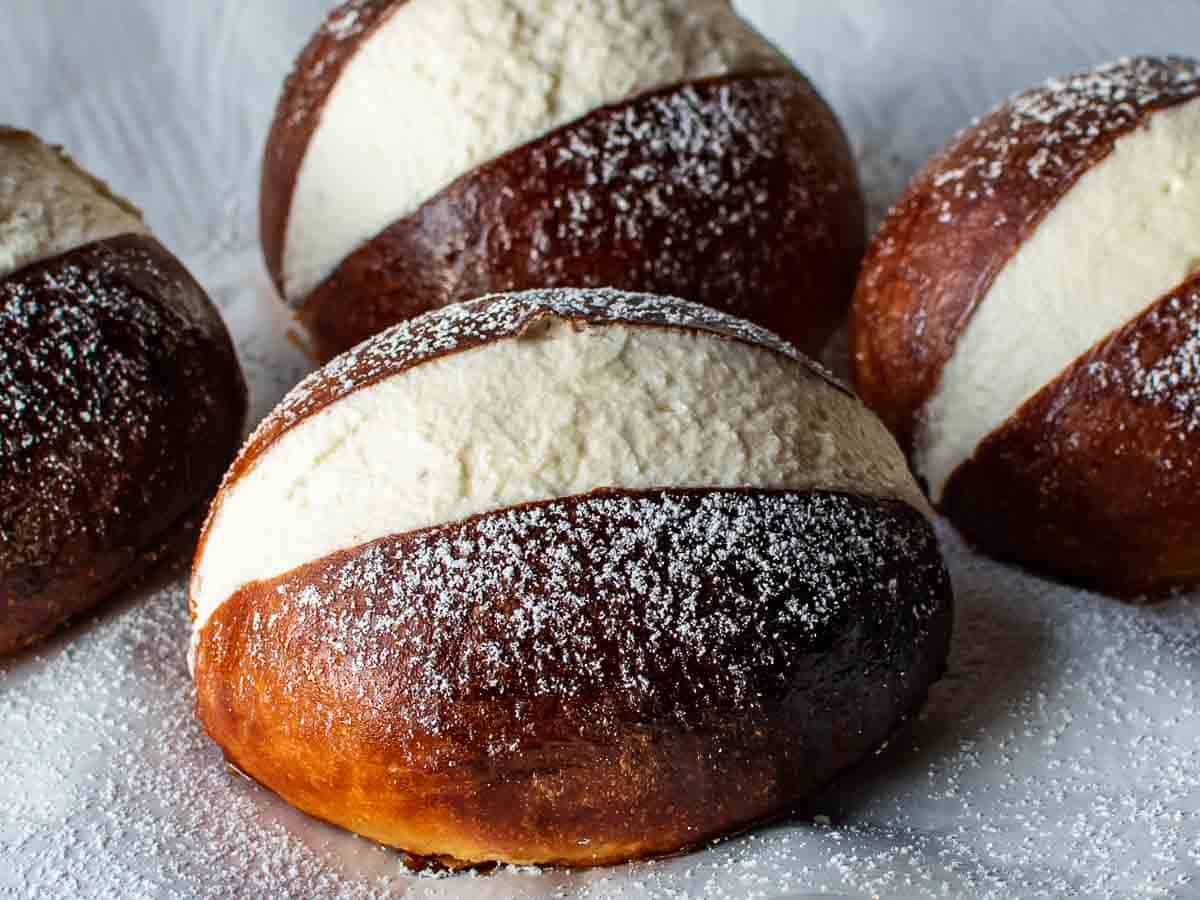
Maritozzi 


Bien entendu, on vient à Rome avant tout pour visiter ses monuments et ses musées. Pour faire, littéralement, une promenade à travers l’histoire. Mais qu'en est-il de sa gastronomie ? Et nous ne parlons pas de spaghetti carbonara ou d'alla gricia, d'agneau ou de cacio e pepe : nous parlons de desserts typiquement romains, qui * moins célèbres que les napolitains ou siciliens * sont en réalité vraiment extraordinaires. On ne peut pas parler des douceurs de Rome sans parler des maritozzi. Typiques du Latium, ce sont de petits pains pétris avec de la farine, des œufs, du miel, du beurre et du sel puis coupés en deux dans le sens de la longueur, de manière à être remplis d'une généreuse dose de chantilly. Où déguster ces petites bombes caloriques qui remonteraient, dit-on, à la Rome antique ? Ces succulents Maritozzi romains sont des petits pains sucrés incroyablement légers et moelleux remplis de beaucoup de crème parfaitement fouettée. Mais vous n’avez pas besoin d’aller à Rome pour en manger un ! Cette recette contient tous les conseils pour que vous puissiez réaliser chez vous des Maritozzi qui satisferont vos envies et donneront vie à vos rêves !

Les Maritozzi sont constitués d’une pâte façon brioche enrichie et pas trop sucrée. Cependant, alors que la pâte à brioche utilise du beurre, maritozzi utilise de l'huile d'olive extra vierge pour créer douceur et saveur. La pâte sucrée peut être façonnée en formes rondes ou légèrement allongées qui sont ensuite cuites jusqu'à ce qu'elles soient bien levées et dorées. Les maritozzi sont coupés en deux sur le côté ou par le haut, mais pas complètement (un peu comme un rouleau à hot-dog), puis remplis de beaucoup de crème fraîchement fouettée et éventuellement d'un saupoudrage de sucre en poudre. La douce tradition des maritozzi remonte aux années 1800 et est entièrement consacrée à l’amour. On raconte que ces petits pains à la crème italienne étaient offerts par les futurs maris à leurs futures mariées le premier vendredi du mois de mars, qui était alors la Saint-Valentin. À l’intérieur de la crème serait cachée une bague de fiançailles ou un autre petit cadeau en or. Une autre légende raconte que les filles cuisinaient de beaux maritozzi pour attirer l'attention des jeunes hommes de leur village. Le futur mari choisissait les maritozzi de la fille qu'il aimait. Quoi qu’il en soit, c’est la façon la plus merveilleuse et la plus délicieuse de dire à quelqu’un que vous l’aimez.

INGRÉDIENTS

Les maritozzi sont faits d'une pâte levée légèrement sucrée qui comprend de l'huile d'olive, du sucre et des œufs. C’est le choix des ingrédients de cette recette italienne traditionnelle qui crée un goût et une texture authentiques.

Farine à pain – facile à trouver en grande surface, cette farine possède une teneur élevée en gluten ou en protéines qui confère à la pâte structure et solidité. Cela permet à la pâte maritozzi de lever et de conserver sa forme.

Lait – choisissez du lait entier pour plus d’humidité et de gras dans la pâte. Des laits végétaux peuvent être utilisés mais la texture peut être légèrement différente.

Œufs – utilisez des œufs gros ou très gros. J'aime utiliser des œufs fermiers, mais utilisez ce que vous préférez.

Sucre cristallisé – le sucre cristallisé blanc est traditionnel pour cette recette. Cependant, vous souhaiterez peut-être expérimenter en utilisant d’autres types de sucre.
Huile d'olive - J'aime utiliser une huile d'olive extra vierge délicate. Choisissez-en un qui n’est ni trop poivré ni épicé.

Levure sèche active – vérifiez la date de péremption sur l’emballage avant de cuisiner pour ne pas avoir de déception.

Miel – le miel ordinaire du supermarché dont vous aimez le goût est très bien. Vérifiez les ingrédients pour s'assurer qu'il s'agit bien de miel pur - certains ne le sont pas !
Zeste d'orange et de citron – J'ai utilisé des oranges et des citrons cultivés sur place que je sais être biologiques. Dans tous les cas, veillez à bien laver les agrumes avant de les zester.

Pâte de gousse de vanille – c'est un peu plus cher que l'extrait de vanille mais ça vaut le coup pour la saveur supplémentaire ! La plupart des supermarchés en stockent et se conservent longtemps.

Du sel – pour rehausser les saveurs de la pâte !

Crème – de la crème fouettée fraîche et épaisse est ce dont vous avez besoin ici. Faites-le bien froid pour de meilleurs résultats de fouettage.

INSTRUCTIONS

Préparez le biscuit pour la pâte maritozzi en mélangeant tous les ingrédients du biscuit dans un petit bol et laissez reposer une heure. Il va bouillonner et monter. Ne vous inquiétez pas s'il tombe tout seul. Mélangez l'éponge aux ingrédients humides à l'aide de la palette du batteur sur socle. Ajoutez progressivement la farine puis pétrissez à l'aide du crochet pétrisseur pendant 5 minutes. Grattez la pâte sur une surface huilée puis pliez avec les mains huilées pour renforcer la pâte. Placer la pâte dans un bol huilé, couvrir et laisser lever. Divisez la pâte levée en huit portions égales. Former une boule légèrement allongée et lever une seconde fois. Badigeonner les maritozzi levés d'œuf et cuire au four préchauffé. Dissoudre le sucre dans l'eau pour le sirop puis faire bouillir 2 minutes. Fouetter la crème jusqu'à formation de pics fermes. Badigeonner les petits pains de sirop de sucre et remettre au four 1 à 2 minutes. Coupez les maritozzi mais pas complètement. Remplissez les maritozzi de crème à l'aide d'une poche à douille ou d'une cuillère. Grattez l'excédent de crème puis saupoudrez les maritozzi fourrés de sucre en poudre.

Indice
Les temps de levée de la pâte maritozzi peuvent différer considérablement en fonction de la température ambiante. S’il fait particulièrement chaud, la pâte peut lever plus rapidement. De même, si la journée est fraîche, le temps de montée sera plus long. Par temps froid, je mets 2 à 3 pouces d’eau tiède dans l’évier de la cuisine et je mets le bol de pâte dans l’eau.

Typical Roman sweets 


Curious to know what are the typical Roman sweets? Do you want to impress your friends with simple and tasty desserts?

Although the origin of these desserts is often unknown, the typical Roman sweets are widespread throughout Italy and are characterized by their goodness and genuine delicacy, derived from simple and "poor" ingredients that reflect the typical cuisine of ancient Rome.

"The finer things in life are either immoral, or illegal, or fattening"
(George Bernard Shaw)

How can you deny that a good delicious dessert is one of the most beautiful things in life? We Romans know it well, our traditions hand down to us recipes of typical Roman desserts to lick your lips! If you are suddenly hungry, you just have to choose whether to eat a good stuffed croissant or a classic maritozzo with cream. 

Typical Roman sweets – a must on the Christmas tables

Even at the end of the year you can't give up typical Roman sweets prepared specifically for the Christmas period, such as bussolani and tozzetti, certainly the most popular in this part of the year, ideal for adding flavor to your tables, thanks to the combination of chocolate, dried fruit, lemon and cinnamon.

Among the other delicacies of typical Roman sweets related to this holiday there are also the "mostaccioli romani", characterized by pepper and cinnamon that give an extra touch of flavor, the almond brittle, irresistible for its honey filling, the gingerbread, characterized by its rich variety of ingredients including cocoa and orange peel, and pangiallo, a loaf-shaped cake made with flour, dried fruit and honey, leavened and then baked in the oven, used even in ancient times to celebrate the arrival of the sun.

oman Mostaccioli are really delicious and super easy to prepare, excellent on any occasion, a great way to eat something sweet without getting too heavy, the problem will be to be able to stop once tasted, and well yes, one leads to another, just like French fries, a real goodness that you can no longer do without and they are so easy and quick to prepare that you will have no problem in making them again Over and over again, a real treat that will surely leave you pleasantly surprised, a dish to be discovered.

INGREDIENTS

Flour 60 g
Walnuts 100 g
Black pepper to taste
Honey 100 g
Egg whites 2
Cinnamon to taste

PREPARATION

Knead the flour with the honey, egg whites, walnuts, pepper and cinnamon. Knead the dough, then roll it out on the work surface. Cut into rectangular strips, transfer them to the oven tray and cook over moderate heat for about twenty minutes. Remove from the griddle when they are completely cooled.


Les origines de Pangiallo remontent à la Rome antique


Signifiant littéralement « pain jaune », le pangiallo est un dessert romain traditionnel consommé à Rome à Noël. Il est composé d'un mélange de fruits secs et confits, de noix, d'écorces d'agrumes, de miel et de chocolat noir qui sont combinés et formés en forme de dôme. Le gâteau est badigeonné d'un glaçage au safran et cuit au four pour créer une croûte extérieure jaune doré et un intérieur dense, riche et collant. Le pangiallo est à l'origine une ancienne recette de l'époque impériale romaine où il était préparé et offert pendant le solstice d'hiver pour souhaiter le retour du soleil, d'où sa couleur et sa forme ronde. De nos jours, le pangiallo est plus difficile à retrouver que les friandises festives plus répandues telles que le panforte ou le panpepato, mais on peut encore le trouver dans certaines boulangeries artisanales de la ville aux alentours de la période de Noël. 

Cependant, préparer le pangiallo à la maison est très simple et remplira votre maison d'un délicieux arôme chaleureux. La recette ci-dessous est une ligne directrice de base, mais vous pouvez également ajouter des figues séchées, des pignons de pin ou des épices comme de la muscade, du gingembre ou de la cannelle selon votre goût. Une fois préparé, il se conserve bien et constitue donc un excellent cadeau de Noël fait maison pour les amis et la famille. Les fruits secs sont également le protagoniste du Pangiallo romain. Un dessert à la croûte dorée, une recette presque perdue qui était habituellement préparée le jour du solstice d'hiver en signe de chance.

Ingrédients

80g d'amandes
80g de noisettes
80g de noix
40g de pistaches
100 g de raisins secs
40 g de fruits confits mélangés
100g de miel
100g de chocolat noir
Le zeste râpé d'1 citron
Le zeste râpé d'1 orange
80g de farine 00

Pour le glaçage
2 petits sachets de safran (2 sachets de 0,1g)
2 cuillères à soupe de farine
2 cuillères à soupe d'huile d'olive extra vierge

Methode

Préchauffer le four à 180° C. Placez le chocolat noir dans un bol en verre au-dessus d'une casserole d'eau bouillante et faites fondre jusqu'à consistance lisse. Pendant que le chocolat fond, hachez grossièrement les amandes, noisettes, noix et pistaches et mettez-les dans un grand bol à mélanger. Ajoutez les zestes de citron et d'orange râpés, les raisins secs et les fruits confits et mélangez bien le tout à l'aide d'une fourchette. Ajoutez le miel et continuez de mélanger en versant progressivement le chocolat fondu. Ajoutez enfin la farine et, une fois combinée, appuyez avec vos mains et formez une pâte compacte. Placez la pâte sur une plaque à pâtisserie recouverte de papier sulfurisé et utilisez vos mains pour lui donner la forme d'un dôme. Pour faire le glaçage doré, mettez 2 cuillères à soupe de farine dans un bol propre, ajoutez l'huile d'olive et le safran et mélangez. Ajoutez ensuite progressivement de l'eau froide, petit à petit, jusqu'à obtenir une texture épaisse et crémeuse. Badigeonnez le dessus du dôme de glaçage jusqu'à ce qu'il soit complètement recouvert, puis faites cuire au four à 180° C pendant 35 à 40 minutes jusqu'à ce que la croûte extérieure soit ferme.


Pepatelli


Another typical dessert of Abruzzo are the pepatelli, they are so called because they are spiced with ground black pepper and are delicious. I left them for the feast of the Epiphany, I was tired of super heavy desserts and these are perfect, light, crunchy and, at the same time, slightly hard, the secret lies in the cut. they must be very thin. The thinner we can make them, the better they will be, a cut that is too thick would make them excessively hard to bite. They are made in 5 minutes and with this small dose you will get a lot of them. Also excellent as a gift 😋😋😋😋😋!

Ingredients

350 g honey
350 g almonds peeled
2 oranges (zest)
1 lemon (zest)
5 g ground black pepper
350 g whole wheat flour

Procedure

Let's start by grating with a grater or cutting the orange and lemon zest into very small pieces with a knife (without the white part). Combine them in a large bowl with almonds, flour and pepper and mix. Dissolve the honey on the gas and once liquid and hot, pour it over the flour mixture. Mix well with the help of a spoon, it will become very hard, if necessary grease your hands with extra virgin olive oil and work it a little. Always with oiled hands (to prevent it from sticking too much) make three loaves (about 5-7 cm wide) and bake at 180°C for about 30 minutes, they should be golden. Once removed from the oven, cut them immediately, use a clean tea towel so as not to burn yourself and to hold the loaf in place while we cut it (we must do it immediately because they are still soft when hot, while if we wait too long they will harden and it will be very tiring). Cut them very thin, as much as we can, about 3 mm. Once cut, place them on a tray to cool (they will do in a moment). Once cold they will become hard and slightly chewy (thanks to the honey), store them in a tightly closed bag or in a tray with a lid. one leads to another 😍😍😍😍😍... Enjoy your meal 🌻🌻🌻🌻🌻!


Street food history Marche, Abruzzo and Molise


LA CRESCIA 

Well, here in Central Italy there are all references from region to region, from city to city. To say: crescia is basically from the Marche region but it can also be found in Umbria and to be honest (don't blame the purists) it is not very different from the more famous and globalized piadina romagnola (and not even from the Tuscan schiacciata). In fact: crescia is a disc of pasta cooked, depending on the area, on the grill, under the embers, on a griddle. The same disc is accompanied or stuffed with sausage, wild herbs, ham, loin, cheese (in Ancona only with herbs, and it is called sa'Zefoje) and that's it. Then there are the variations: the puff pastry from Urbino, the one made with leftover polenta from Jesi, etc., but the substance changes little. You eat on the street, of course, but also at a restaurant, well put on your plate.


ASCOLANA OLIVES

Ascoli olives are the perfect street food: you pinch them easily with your fingers, each one is a bite, and while you're chewing one you're already thinking about the next one. Everyone knows them, but perhaps not everyone knows that: the olive must be the "ascolana tenera", the PDO one, green, large, soft; there must be beef, pork, and chicken inside; the breading should not be exaggerated; The frying, of course, perfect. To be honest, the best way to eat them is to have your own fryer: in Ascoli, and elsewhere in the Marche region, the best sellers are the butchers, who therefore sell the bombette nice and ready but still to be cooked. Nevertheless, there is no shortage of stops to enjoy them (and there are also many other pieces of the "fritto all'ascolana", i.e. cremini, zucchini, artichokes, zucchini flowers, ribs). Don't miss them: munching on olives is the way to happiness.


FRIED FOOD AND SEAFOOD GASTRONOMY

Anyone who has ever been to the fish market in San Benedetto del Tronto at five in the morning knows what the Adriatic is capable of. Lord, what comes out of those nets! There are many ports in the Marche, Abruzzo and Molise where, at the fishermen's stalls, freshly caught fish is sold raw (coquillage) and fried, but also prepared in a thousand ways. Examples? Fried squid, prawns, paranza, octopus, seafood, mackerel, snails, cod, marinated anchovies, baked cuttlefish, dogfish with tomato sauce.


SANDWICHES WITH TRIMMINGS

If once upon a time the sandwich with trimmings was all the rage under the arcades of the Foro Annonario in Senigallia, now it is almost impossible to find it. That said, it is practically the Marche version of the sandwich with Tuscan lampredotto or the bread with Sicilian spleen: the trimmings are the guts of the suckling veal, the same used in the Lazio pajata. They are roasted on the grill seasoned with garlic and rosemary and stuffed in the middle of a rosette. The effect? Butter that melts in your mouth!


ARROSTICINI (OR ROSTELLE)

In Pescara, the arrosticini, slender skewers, go down, which is a beauty, and before you know it you will have eaten about twenty of them. Maybe it's because the meat morsels are small, maybe it's because the sheep (or mutton) are tasty, maybe it's because the grilling flavors even more, but it's impossible to stop. Nowadays they are eaten all over Italy, but just as they are good in Abruzzo, they are only good in Abruzzo.


THE TORCINELLI (OR TUNCENELLE)

Torcinelli are the symbol of Molise street food, even if in reality - in a wonderful food syncretism - they are practically identical to the Apulian gnummareddi and even to the Sicilian stigghiola. It is a roll of liver and tripe and lamb intestines seasoned with salt, pepper, chilli and parsley cooked on the grill. They are the most popular in the province of Campobasso and you will easily find them in butchers but also in the braziers that serve them prèt-à-manger. The recipe for tuncenelle in Abruzzo is more or less identical, but they change their name from place to place: tuncenelle, in fact, in Chieti, but mazzarelle in Teramo (in reality, mazzarelle is easier to be cooked in a pot and served at the table) and marra in L'Aquila. If you find a skewer stand, it's easy for them to have them too.


THE PIZZAS OF THE ADRIATIC

Whether you are in the Marche, Abruzzo or Molise, in the chalets by the sea you cannot fail to eat a pizza. The "pizzetta dell'Adriatico" is the perfect snack: a tasty headband cooked in a mini pan, which is also eaten stuffed and usually does not exceed one euro. In summer it is the classic meal between one bath and another and in the area of Pesaro there is also the "pizzetta dei tedeschi" version, that is, with mayonnaise on top. In Campobasso there is also a beautiful tradition of pizza by the slice.

Hello everyone, here I am again to present you a new recipe the  Adriatic pizza, this new year. 

Let's get down to the recipe!

Ingredients

490 gr of rustica (type 2 flour)
200 gr of flour
1.5 gr of dehydrated brewer's yeast
420 gr of cold water from the fridge
15 gr of extra virgin olive oil
15 gr of fine salt

Procedure

As a first step, sift the flours in the bowl of a stand mixer or in any bowl, if kneaded by hand. Add the water and work very coarsely with a fork, cover and refrigerate for 30 minutes. After the time in the fridge, take out your autolytic dough, add the yeast and start kneading, add the oil and finally the salt. Bring the dough to stringing, then transfer it to the work surface, roll it out and let it rest covered with a bell for at least 30 minutes. At this point, make a round of three folds, put the dough in a bowl greased with oil, cover with plastic wrap and leave to mature in the fridge for 24 hours. After the fridge stop, take out and let the dough acclimatize for an hour. You can now move on to cutting the loaves by doing so. Divide the dough and at each portion, make rounds of folds, roll the balls and let them rise one last time, covered well, until doubled. Now you can roll out your pizzas and top them as you like, on this occasion I stuffed them with seafood from my beautiful Adriatic Sea, you stuff as you like. My amazing Adriatic pizza is ready to be enjoyed.
GNAM GNAM!


Piadina with Rocket Pesto, Artichokes, Stracchino and Ricotta

Is a gourmet proposal that combines goodness and lightness. The delicious homemade rocket pesto, the artichokes quickly blanched in acidulou...